In your first year, an open studio membership in most US markets lands somewhere between $150 and $325 a month, but that range is useless to you as a target. The only number that matters is the one you build from your own lease, your own kilowatt hour rate and your own staffed hours. Price the membership so that a full studio covers fixed costs, staffing and consumables with a margin of at least 20 percent, and so that a half full studio still covers rent and insurance.
The practical method is to work out the monthly cost of carrying one member, then add margin, then check the result against what your local market will actually pay. If the honest cost number comes out above what the market pays, the problem is your capacity or your space, not your price list.
Here is how to build it, part by part, with arithmetic you can redo on your own numbers in about an hour.
What a membership actually buys the member, written down
Before you can cost anything, write the membership definition in plain sentences. Vague memberships bleed money because every ambiguity gets resolved in the member's favor at the counter.
A workable definition covers seven things: hours of access, wheel access and whether it is reserved or first come, shelf space, what firing is included, what glazes are included, whether clay is included, and what happens when the member stops paying.
An example that costs out cleanly: access during staffed hours seven days a week, one reservable wheel session of three hours per day, one 12 by 24 inch ware shelf, bisque and cone 6 glaze firing included up to the shelf's capacity, house glazes included, clay purchased separately, and 30 days to collect work after cancellation.
Notice what that does. Shelf size caps firing volume, which is the single most dangerous unlimited in this business. A member cannot fire more than fits on their shelf, so your kiln load per member is bounded by a physical object you can point at.
Keep reading: What do OSHA and my local code actually require for silica dust in a studio?
Cost per member per month: rent, insurance, utilities, staffing
Take your fixed monthly costs and divide by the number of members the space can genuinely hold. That capacity number is the one people get wrong. Capacity is not square feet divided by an ideal. It is set by wheels, wedging tables, sink access and shelf wall.
Assume a 2,400 square foot studio at $18 per square foot per year triple net, which is $3,600 a month in base rent. Add $700 in NNN charges, $250 in general liability and property insurance, $180 in internet and software, $120 in trash and recycling with a clay trap service, and $400 in non kiln utilities. Fixed overhead is $5,250.
Staffing: two part time studio techs covering 45 hours a week between them at $22 an hour fully loaded, which is about $4,290 a month. Add your own draw only after you have seen whether the model works.
Capacity: 10 wheels, 40 shelf slots on the wall, one glaze room. Members do not all come at once, so a common working ratio is four members per wheel in a studio open long hours, plus a hard ceiling at the number of shelves. Forty shelves is your real ceiling. Assume you fill 32 of them in year one.
Fixed plus staffing is $9,540. Across 32 members that is $298 per member per month before a single kiln has been fired. That number is the reason studios with too few shelves and short hours fail.
Metering the kiln: what a firing really costs in electricity
People wildly overestimate this. Do the arithmetic once and you will stop worrying about it.
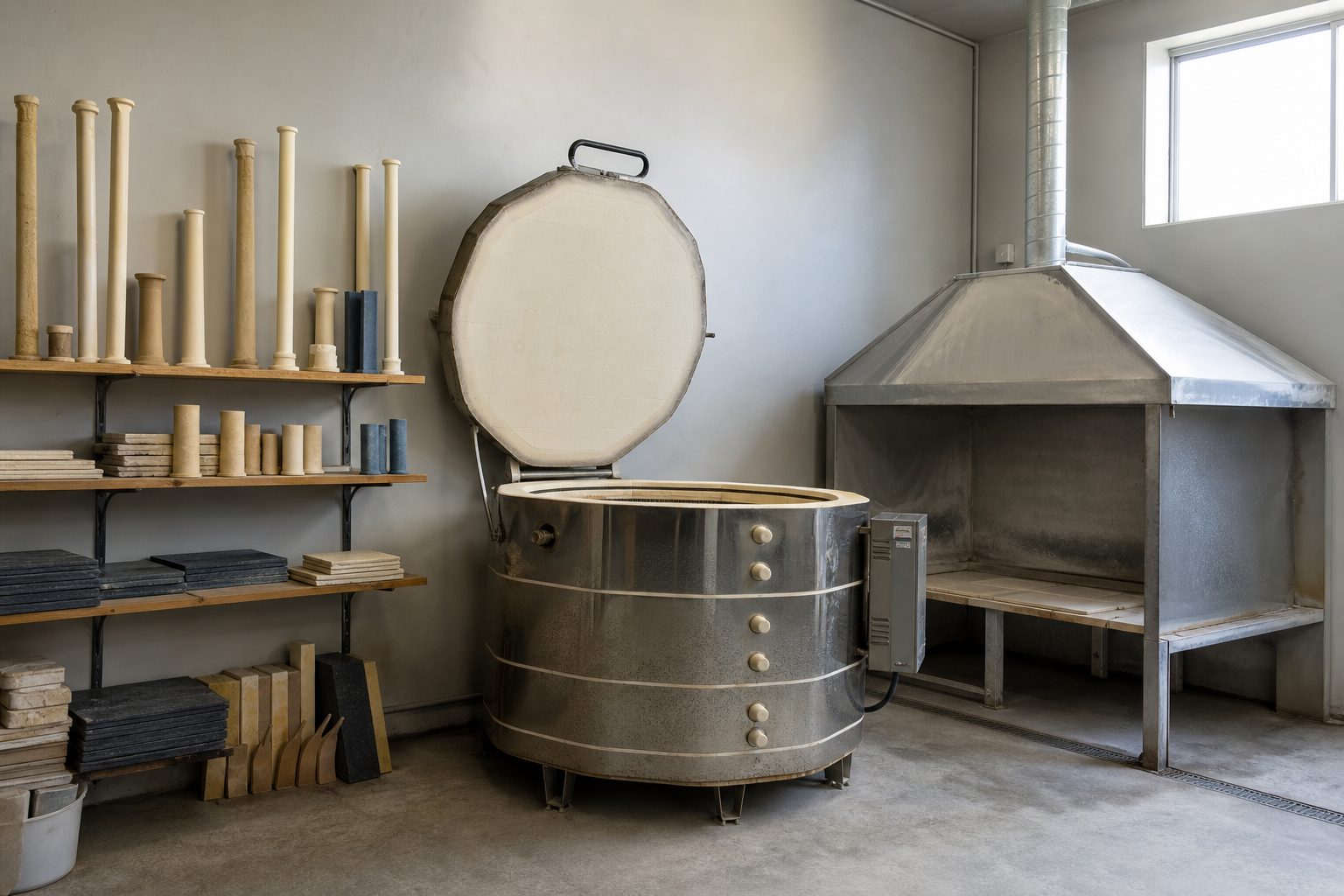
Take a seven cubic foot electric kiln rated 48 amps at 240 volts single phase. That is 11.5 kW at full draw. A kiln does not pull full power for the whole firing: the elements cycle, and the controller throttles the ramp. Over a cone 6 glaze firing of roughly nine hours, an average duty cycle of 60 percent is a reasonable working assumption for a kiln with good elements and a tight lid.
11.5 kW multiplied by 9 hours multiplied by 0.60 is about 62 kilowatt hours. At a commercial rate of $0.16 per kWh, that is roughly $10 of energy. A bisque firing runs longer but cooler and lands in a similar place, call it $11.
These are assumptions, not measurements. Put a clamp meter or a submeter on the kiln circuit for one month and replace them. Also check whether your utility bills demand charges, because a commercial account with a demand component can make a single kiln more expensive than the energy math suggests. Demand charges are billed on your highest 15 minute draw, so firing two kilns simultaneously at peak can cost more than the kilowatt hours imply.
If a member fills a shelf and that shelf translates to roughly one third of a kiln load, bisque and glaze, your energy cost per member per month is on the order of $7 to $15. It is real, but it is not what sets your price. Elements, shelves and the tech's time to load are the expensive part of firing, not the electricity.
Keep reading: Should I fire cone six electric or invest in a gas reduction kiln for my studio?
Glaze, slip and shared tool consumption per active member
Dry glaze materials for a house palette of six to eight cone 6 glazes cost roughly $2.50 to $4.50 per gallon mixed, depending on how much tin, cobalt and rutile you use. A studio of 32 members mixing in house will move through 12 to 20 gallons a month in a busy season.
Budget these consumables per member per month:
- House glaze and slip: $9
- Kiln wash, stilts, silicon carbide grinding: $3
- Shared tools, sponges, bats, banding wheel replacement: $4
- Element and thermocouple sinking fund: $12
- Kiln shelf and post replacement fund: $6
That is $34 a member. The last two items are the ones new owners skip. A set of elements for a seven cubic foot kiln plus a technician's time runs several hundred dollars and is due every 100 to 175 glaze firings depending on how hard you push cone 6. Put money aside monthly or the bill will arrive as a crisis.
Choosing between unlimited, tiered and punch card models
Unlimited is simple to sell and hard to cost, unless you cap firing with shelf size as described above. Tiered pricing lets you sell the same room twice: a day member who comes Tuesday at 11am costs you nothing extra if your evenings are full.
| Model | Best when | Main risk |
|---|---|---|
| Unlimited, shelf capped | Long hours, shelf wall is the constraint | Evening wheel congestion |
| Tiered by access window | Daytime capacity is going unused | Members gaming the cheaper tier |
| Punch card, 10 sessions | Post class retention, seasonal towns | Unpredictable firing volume |
| Wheel reservation add on | Fewer than one wheel per four members | Feels like nickel and diming if unclear |
A studio with a real evening crunch should not solve it with price alone. Booked wheel sessions with a no show rule fix the crunch and let you keep a single clean price.
See how KilnSeat handles this for pottery and ceramics studios
What firing fees, clay sales and shelf rental add on top
Ancillary revenue is where a marginal membership price becomes a viable business. Three lines carry most of it.
Clay
Buying a stoneware body by the pallet and selling it by the 25 pound bag is normal and expected. If a pallet lands at a delivered cost near $13 a bag and you sell at $22, each member buying two bags a month contributes $18 of gross margin.
Overflow firing
Work that does not fit the included shelf goes on the firing queue at a per piece or per cubic inch rate. Charging by volume is fairer and easier to defend than charging by piece, since a single wide platter can eat a whole shelf.
Extra shelf rental
A second shelf at $28 a month is close to pure margin once the wall exists, and it is the cleanest way to let a productive member pay more without changing the base price for everyone.
Setting a floor price and a review date
Stack the numbers. Fixed and staffing at 32 members: $298. Consumables and sinking funds: $34. Kiln energy: $12. True cost per member is $344 a month.
That is your floor at 32 members, and it is above what many markets bear, which tells you something important: at $344 you either need more shelves in the same rent, or you need ancillary revenue to carry part of the load. If clay margin and extra shelves bring in $40 per member per month, your membership can sit at $325 and the studio still clears its costs with a thin margin. Push shelves to 40 and fixed cost per member drops to $239, and $325 starts to look healthy.
Set a review date in writing at six months. Recalculate with actual kilowatt hours, actual glaze spend, actual filled shelves. Tell members at signup that rates are reviewed annually with 60 days notice, so the first increase is a policy you announced rather than a surprise.
Where to go from here
The arithmetic above only holds if you know how many shelves are occupied, who is booking which wheel, and what is actually sitting in the kiln queue this week. On a clipboard, those three numbers drift within a month.
KilnSeat keeps membership billing, wheel booking, shelf allocation and a visible kiln queue in one place, so the capacity numbers you priced against are the numbers you can look up. Build your floor price on paper first, then run the studio against it.