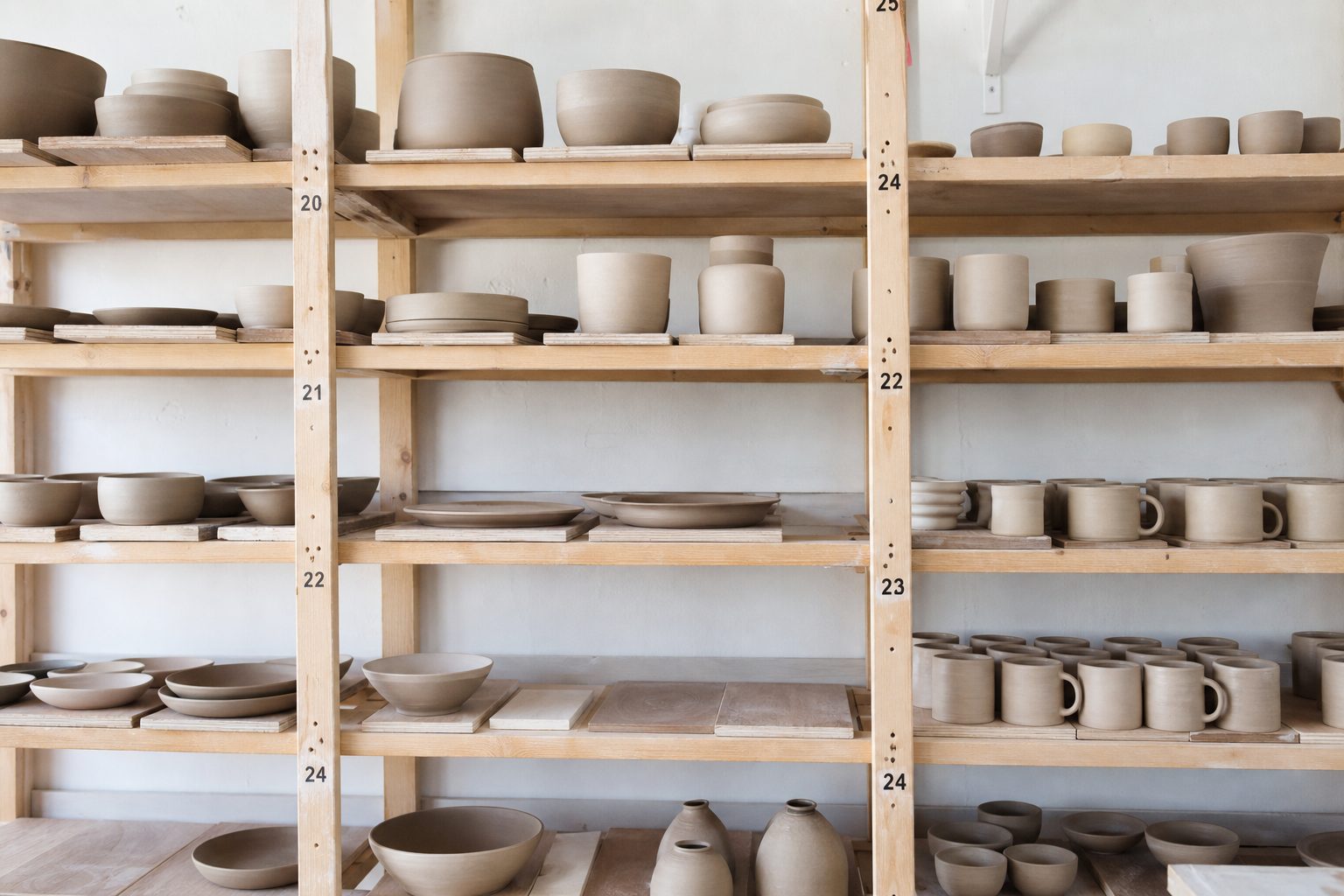
Members lose work in the bisque queue because the pot loses its name, its shelf, or its place in line, and usually all three at once. The kiln is almost never the problem. A well maintained electric kiln fires what you put in it. The failure happens in the twelve to twenty days between a pot leaving the wheel and a member carrying it out the door, when it sits on a shared shelf with forty other pots that look roughly the same shade of gray.
Fix it by treating the studio as a small production line with named handoffs. Every pot has one identifier that survives 1888F. Every shelf has one purpose. One person decides what loads. And the firing schedule is published where members can see it without asking you, because the question "is my bowl out yet" is the tax you pay for an invisible queue.
Here is how to build that, stage by stage, in a studio that has no extra staff and no extra room.
Mapping the journey of one pot from wheel to pickup
Before you change anything, walk one pot through your studio and write down every place it physically rests. In most community studios the honest list runs like this.
- Wheel or handbuilding table, wet
- Member's personal shelf, drying under plastic
- Trimming, back to the wheel, back to the shelf
- Damp room or damp box if attachments are pending
- Bone dry greenware shelf, staged for bisque
- Kiln, bisque fire, usually cone 04
- Bisque return shelf
- Glaze area, dipped or brushed, wiped foot
- Glaze staging shelf
- Kiln, glaze fire, cone 6 or cone 10
- Finished pickup shelf
- Out the door
Eleven resting places. At every one, a pot can be picked up by the wrong person, pushed to the back, or set down without its board. Count how many of those eleven places in your studio are actually labeled and assigned. If the answer is fewer than six, you do not have a kiln problem, you have a furniture and signage problem, and it is cheap to fix.
The two highest risk handoffs are step 5 to 6 and step 6 to 7. That is where a pot leaves member control and enters studio control, and where nobody currently owns it.
Keep reading: How do I decide how many wheels and how much shelf space one member needs?
Labeling that survives bisque and glaze temperatures
Any label that is paper, tape, or marker on the pot will be gone after the bisque. That is the whole cause of the orphan shelf. You need marks that live through both firings.
Marks that work
Underglaze pencil or underglaze on the foot. Written on leather hard or bone dry ware, it survives bisque and it survives a cone 6 glaze fire if the mark is on the foot ring where glaze is wiped. This is the most reliable option and costs a few dollars a year.
A stamped member number pressed into the clay. Small brass or bisque stamps with two or three digits, pressed into the foot when the piece is trimmed. Permanent, unmistakable, and impossible to smudge. Give every member a number at signup and it never changes.
Marks that fail
Masking tape burns off. Sharpie burns off. Pencil on greenware burns off. A tag tied to the handle burns off and can leave a carbon smudge on a neighbor's pot. Colored rubber bands on the shelf edge fall off when the board moves. None of these should be your system of record.
The practical rule: the pot must be identifiable when it is naked, alone, and on the wrong shelf. If a piece can only be identified by where it sits, it will eventually be lost.
Ware carts, green shelves and the damp room handoff
Personal member shelves should hold work in progress only. Greenware ready to fire belongs somewhere else, and that somewhere else should be a rolling ware cart, not a wall shelf.
Carts win for a simple reason: you can wheel a full cart to the kiln room and load directly off it, instead of carrying pots one at a time across a busy studio. Fewer trips, fewer elbows, fewer chips.
Set up three carts if you can afford them, labeled clearly:
- Ready to bisque. Members place bone dry work here themselves. Placing it here is the member's declaration that the piece is finished and dry.
- Bisque out, ready to glaze. You unload the kiln onto this cart. Members retrieve their own pieces from it.
- Ready to glaze fire. Glazed, feet wiped, and by placing it here the member is confirming the foot is clean.
The damp room is a separate question and should not be part of the firing queue at all. Damp storage is for work waiting on handles, feet, or attachments. Give it a hard time limit, two weeks is typical, and post that limit on the door. A damp room with no expiry becomes a mold farm and a storage unit.
Keep reading: What are the most expensive mistakes new studio owners make in their first two years?
Loading rules: who decides what goes in the next firing
Democratic loading does not work. Somebody has to decide, and that person should be you or a named studio tech, never whoever happens to be in the room.
Write the loading order down and post it. A defensible order that most studios can live with:
- Anything left over from the previous load, oldest first
- Class work with a fixed end date, because a class ends and students leave
- Member work in date order by the date it hit the ready cart
- Studio work, sample tiles, and your own pots, always last
Two rules make the system honest. First, your own work goes last, publicly. Members notice when the owner's mugs jump the line, and it destroys trust faster than a slow queue ever will. Second, no piece skips the line for a birthday, a craft fair or a gift deadline unless you sell a paid rush option with a real price and a real limit, for example two rush slots per firing at fifteen dollars each. A rush option with a price is fair. A rush favor is favoritism.
Also settle the cone question up front. If your studio fires bisque to cone 04 and glaze to cone 6, say so in writing, and refuse cone 10 stoneware and cone 06 low fire commercial glazes unless you run separate firings. Mixed cone work in one load is how a member's entire semester ends up as a puddle on a shelf.
Publishing the firing schedule so nobody has to ask
The single biggest reduction in your own interruptions comes from turning the firing calendar into something members can read themselves.
At minimum, publish four things for each upcoming firing:
| Field | Example | Why members need it |
|---|---|---|
| Load date and time | Tue Mar 10, loading closes 6pm | Tells them the deadline to get work on the cart |
| Type and cone | Bisque, cone 04 | Stops cone mismatches before they happen |
| Kiln | Kiln B, 7 cubic feet | Sets expectations on how much fits |
| Expected unload | Thu Mar 12, after 2pm | Ends the "is it out yet" question |
Add the cool down honestly. A 7 cubic foot electric kiln firing to cone 6 typically needs a full overnight and often a second morning before it is safe to open, and cracking it early is how you get dunting across a whole shelf.
If members can see the queue position of their own pieces, the volume of questions collapses. That is the practical case for tracking the queue in software rather than on a whiteboard: a whiteboard cannot be read from home at nine at night, and nine at night is when the question occurs to people.
See how KilnSeat handles this for pottery and ceramics studios
What to do with unclaimed and orphaned work
Every studio accumulates two piles. Unclaimed work belongs to someone who has not picked it up. Orphaned work belongs to nobody identifiable. Handle them differently.
For unclaimed work, set a written window from the unload date. Thirty days is common and reasonable. Notify at day fourteen, notify again at day twenty five, and state in your membership agreement what happens at day thirty one: the studio may donate, sell, or recycle the piece. Actually enforcing this once, gently, teaches the whole room.
For orphaned work, run a monthly amnesty shelf. Put unidentified pieces on one clearly marked shelf with the unload month written on the shelf edge. Give it sixty days. Anything still there goes to a sale table, a donation box, or the shard pile. Photograph the shelf and post the photo where members can see it, so nobody can say they were never told.
Handling breakage and setting the policy in advance
Pots break. Some break because a member left a wall too thin or trapped air in a handle. Some break because a shelf was overloaded or a post shifted. Some break because someone bumped a cart. Your policy should distinguish these plainly and without drama.
A workable three part policy:
- Kiln accidents and material failure. The studio does not replace work damaged in firing. Clay bodies fail, glazes run, thermal shock happens. This is stated at signup and repeated on the firing form.
- Studio handling damage. If a staff member or tech breaks a piece while loading or unloading, the studio refunds that piece's firing fee and, if the member paid for the clay, credits a bag of clay. Small, specific, and cheap enough that you will actually honor it.
- Member to member damage. The studio does not adjudicate. This is why carts are labeled and why members retrieve their own work rather than digging through other people's.
Say the quiet part out loud in the handbook: a piece that runs onto a shelf costs the studio a grind or a new shelf. A published shelf damage fee, say twenty five dollars, does more for wiping habits than any amount of reminding.
Where to start this week
Pick the two changes with the best ratio of effort to relief. Buy underglaze pencils and assign every member a permanent number. Label three carts and stop letting greenware live on personal shelves. That alone will remove most of the lost work in a month.
Then get the queue out of your head and onto something members can check themselves. KilnSeat tracks each piece from the ready cart through bisque, glaze and pickup, publishes the firing calendar with cone and expected unload time, and shows every member exactly where their own work sits in line. The clipboard stops being the system of record, and the question stops arriving at nine at night.