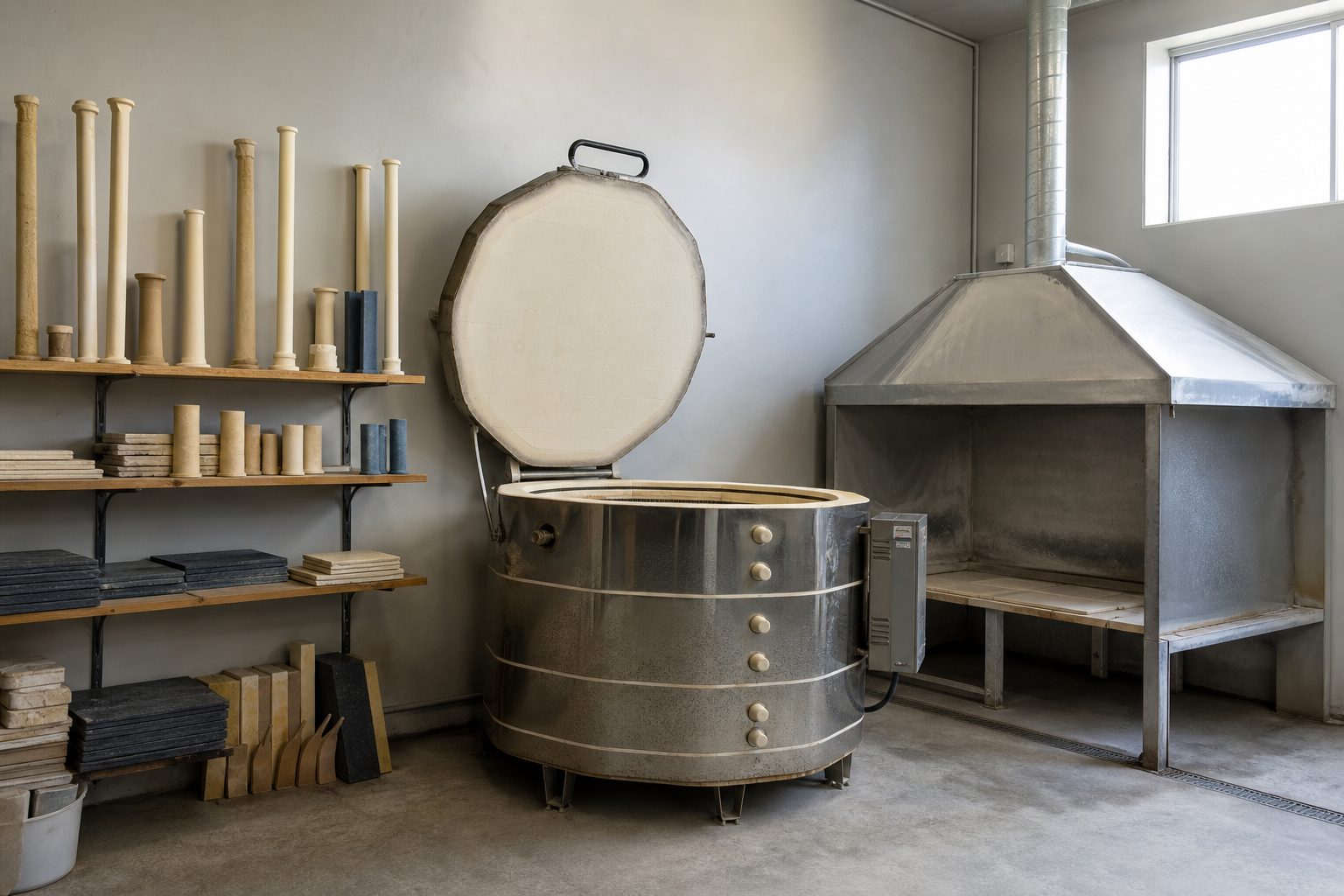
Demand for hands on clay instruction has been strong enough for long enough that planning for more members is reasonable. Plan for it carefully, though, because the demand is not evenly distributed across the week or the year, and the constraint on most studios is not interest. It is shelf space, wheel hours and kiln throughput.
The honest answer to the second half of the question is that you should plan for more members only in the specific hours and formats where you can prove you are turning people away. A studio with a 30 name waitlist and eight empty wheels on Wednesday morning does not have a capacity problem. It has a scheduling problem, and building more space would make the economics worse, not better.
What follows is a way to read your own numbers rather than a market forecast. There is no reliable national dataset on community ceramics studios, and anyone quoting one at you should be asked for the source.
What is driving sustained interest in clay classes
Several forces point the same direction, and they are worth separating because they age differently.
The screen fatigue driver is the durable one. Remote and hybrid work removed a lot of incidental physical activity and in person contact from adult life, and a three hour class where you cannot look at your phone because your hands are covered in slip answers that directly. That is not a fashion. It is a structural change in how people spend evenings.
The social driver is close behind. A six week course with the same eight people is a friendship structure, which is why studios that seat students at shared tables convert better than studios that line wheels along a wall. People are buying company as much as skill.
The visibility driver is the volatile one. Clay looks extraordinary on video, and short form platforms have made throwing and glaze pours into recognizable content. That brings people through the door who have never touched clay, and it also fades on a platform's timetable rather than yours. Treat traffic from that channel as a bonus, not a base.
There is also a supply side factor: making has become cheaper to try and more expensive to do properly. Anyone can buy air dry clay. Almost nobody can install a kiln in an apartment. The studio owns the barrier, and that is a good position.
Keep reading: How much should I charge for an open studio membership in my first year?
Seasonality: the fall and holiday curve every studio feels
Ceramics runs on an academic and gift shaped calendar. The pattern is consistent enough that you can budget against it once you have two years of your own data.
| Period | Typical demand | What it means operationally |
|---|---|---|
| January to March | Strong class signups, resolution driven | Beginner sections fill; retention through spring is the test |
| April to May | Steady, member heavy | Good window for maintenance and element changes |
| June to August | Softest for adult classes, strong for kids camps | Camps can carry the summer if you have daytime staff |
| September to October | Peak signups | The single most important enrollment window of the year |
| November to mid December | Peak kiln load, holiday gift making | Firing queue backs up; this is when members get angry |
| Late December | Quiet, cancellations | Expect churn; prepay incentives help |
The November trap is worth naming. Interest peaks at the same moment as glaze firing volume, because every member wants six mugs finished before the holidays. If your kiln capacity is sized for average months, you will spend December apologizing. Size the queue for November, or publish a hard cutoff date for holiday work in October.
Signals worth tracking in your own numbers
Five numbers tell you almost everything about whether growth is real or seasonal. Record them monthly.
- Wheel utilization by hour block. Booked wheel hours divided by available wheel hours, split into weekday daytime, weekday evening and weekend. One number for the whole week hides the answer.
- Shelf occupancy. Occupied member shelves divided by total shelves. This is your true membership ceiling.
- Class fill rate by section. Seats sold divided by seats offered, per section, not averaged.
- Course to membership conversion. Of students finishing a beginner course, the share holding a paid membership 60 days later.
- Member tenure and monthly churn. Cancellations divided by members at the start of the month. A studio losing four of 50 members a month is replacing its entire base each year.
Read them together. Rising signups plus rising churn means you are filling a leaking bucket, and more capacity would only make the leak larger. Flat signups plus rising tenure and high evening utilization is the profile that actually justifies expansion.
The one calculation to run before any growth decision
Compute peak block utilization: booked hours in your busiest block divided by available hours in that block. If Tuesday to Thursday evenings run above 85 percent for three consecutive months while your daytime blocks sit below 40 percent, you have a time problem you can solve with pricing and programming. If every block is above 75 percent, you have a real capacity problem.
Keep reading: What do OSHA and my local code actually require for silica dust in a studio?
Expanding by hours, by space or by second location
These are three different businesses and they fail for different reasons. Take them in order, cheapest first.
Expand by hours. Open earlier, stay open later, add a Sunday block, add an early morning open studio. The marginal cost is staffing plus a little utility load. Rent does not move. This is almost always the right first move, and it is the one owners skip because it is unglamorous.
Expand by space. Take the adjacent suite, add wheels, add shelving, add a kiln. Now you are committing to new rent every month whether or not the demand shows up, plus electrical work, plus possibly a change of use review. Expansion by space needs demand that has been demonstrated for at least two full seasons, not one busy fall.
Expand by second location. This is not more of the same, it is a new business with your name on it. You will need a manager who can run a floor without you, duplicated kiln capacity, a separate lease, and a second local market that may behave nothing like your first. Most studios that struggle here underestimated the management layer, not the demand.
Clay and material costs and how to hedge them
Clay is heavy, which means the freight component of its cost is large and moves with fuel prices rather than with clay prices. A studio buying from a distributor two states away is buying diesel as much as stoneware.
Work an example. Suppose you use 60 bags of 25 lb stoneware a month, delivered at $19 a bag, which is $1,140. A 12 percent increase driven by freight adds about $137 a month, or roughly $1,640 a year. That is not fatal, but it is invisible unless you are watching, and it comes out of the same margin as everything else. These figures are illustrative; substitute your own invoices.
Practical hedges, in order of usefulness:
- Buy by the pallet rather than the bag. Freight per bag falls sharply, and clay stored damp does not spoil.
- Standardize on fewer clay bodies. Two bodies, one light and one dark, buy in larger lots and simplify glaze fit.
- Reclaim seriously. A pugmill and a member trained reclaim routine converts scrap that is currently a disposal cost back into stock.
- Index your member clay price. State on the price list that clay pricing is reviewed each January and follows supplier cost, so an adjustment is expected rather than a betrayal.
- Watch the electricity side too, since kiln load is your other input that moves with commodity prices.
See how KilnSeat handles this for pottery and ceramics studios
Competition from paint your own and mobile class formats
Paint your own pottery shops and mobile clay parties are not really competing for your members. They compete for the one time experience dollar: birthdays, date nights, team events, tourists.
The overlap is at the top of your funnel. Someone whose first exposure to clay is a two hour mobile wheel party may then look for a real six week course, and you want to be the studio they find. Some studios lean into this deliberately, running their own one off workshops as a paid acquisition channel that converts to courses and then to memberships.
The genuine competitive threat is different: another full service membership studio opening within a fifteen minute drive, especially one with more kiln capacity or longer hours. Your defense is not price. It is shelf availability, a firing queue people trust, and a community that would be socially costly to leave.
Deciding when a waitlist justifies a build out
A waitlist number on its own justifies nothing, because most waitlists are stale. Use a rule with four conditions, and require all four.
- Shelf occupancy has been above 95 percent for six consecutive months.
- Your peak block utilization is above 75 percent and your off peak blocks are above 50 percent, meaning the cheap fix is already exhausted.
- The waitlist converts. Of people offered a spot in the last six months, more than half accepted within their hold window.
- Monthly churn is under two percent, so new capacity will be filled by growth rather than by replacement.
If all four hold, model the expansion at 60 percent of the new capacity filled, not 100, and check that the added rent, utilities and staffing still clear at that level. If the plan only works at full occupancy, it is not a plan.
Planning capacity you can actually see
Every judgment above rests on knowing your utilization by hour block, your shelf occupancy and your conversion rate as facts rather than impressions. Most studios cannot answer those questions because the bookings live in text messages and the shelves live on a whiteboard.
KilnSeat records memberships, wheel bookings, shelf allocation and the firing queue in one place, which means the utilization numbers exist as a byproduct of running the studio. Decide on expansion from your own data, in the specific hours where you can show the demand is real.